Grace in the Complexity

Although my Dad and I had similar personalities, low-level tension, mostly unspoken, lurked between us all my adult life until his death in 2009. In high school I committed my life, by walking to the front of a church service during the altar call, to “full-time Christian service,” assuming I would, like Dad, become a church pastor. But when I was a sophomore in college—majoring in religion and minoring in speech, what better preparation for a preacher?—he abruptly abandoned his church and his family.

He, apparently—I had no clue; I was blissfully in love with Jesus—experienced an unmanageable rebellion at the church where I had joyfully, triumphantly, walked the aisle. Dad was in such psychic pain that he believed he had to escape (to where, I still do not know) for his own sanity. He left some notes describing his agony and vague intention to start a new life—somewhere.

That unrealistic plan, predictably, didn’t work, and he returned in a few weeks. But the harm was done. I discovered his main antagonists were my valued Christian mentors, thus my personal and spiritual confusion—and resentment—began.

We in the family were obligated (without it being overtly stated) to never ask him about his escape and return, so my bewilderment  and anger stayed below the surface. When I visited Mom and Dad, things were mostly jovial and fun (he loved to make jokes and laugh), but the tension remained.

After his brief exile and return, he was secularly employed for a few years, then returned to being a traditional Mississippi Baptist pastor. I attended seminary and achieved master’s and doctorate degrees and joined a liberal Baptist church in Atlanta. I disdained churches that weren’t theologically sophisticated or engaged with social issues: churches like Dad’s. He didn’t care much for the academic study of religion, to which I had devoted nine years. Our lines were drawn.

Recently, thanks to my Mom, who keeps just about everything (especially pictures and letters), while going through old boxes at her house, I discovered a letter Dad received in 1994.

It was from George Wardlaw, a childhood friend of Dad in tiny Baldwyn, in northeast Mississippi. Born one year apart, they were years-long schoolmates. They encountered each other one day in 1947 on a Baldwyn street. Wardlaw was recently discharged from the Navy and returned to his family’s sharecropper cotton farm. Dad was home on a break from college. Dad asked him if he still enjoyed drawing, something he was known for. When Wardlaw said he did, Dad “convincingly” encouraged him to attend an art school in Memphis, Tennessee.

Forty-seven years later, he wrote Dad a thank-you letter.

Within weeks of their sidewalk chat, Wardlaw had enrolled at the Memphis Academy of Arts. Soon, a painting of his was part of a nationwide traveling exhibit sponsored by a New York art museum. His career took off from there. Wardlaw earned a BFA at that Academy and an MFA at the University of Mississippi. Later, he was chair of the Art Department at the University of Massachusetts at Amherst for 20 years.

He became a highly regarded award-winning artist with exhibits in museums and galleries around the country, including the Metropolitan Museum in New York and the National Gallery in Washington DC. In 1982 he was awarded the Mississippi Institute of Arts and Letters award. He was not famous, but in the art world he was well respected in painting, silver work, sculpture, and a hybrid 3-dimensional form that he called “an equal marriage between painting and sculpture.”

One New York art critic wrote that Wardlaw “has produced a rich and varied body of work whose scope defies the limits of a human lifetime, an output that resonates with the insights he has gained in the spiritual quest that eventually led him from Christianity to Judaism.” (He converted in 1955.) Like me, much of his art incorporated spirituality.

He wrote to Dad that he had watched a television program about “conversation related to things that have significantly changed one’s life. I made myself a promise…that I would write to you and thank you for making the suggestion that resulted in one of the greatest and most important changes in my life. Your recommendation that I go to art school and your identifying the Memphis Academy of Arts as a place to consider set in motion for me a very happy lifelong career in art.”

Perhaps Wardlaw would have become a thriving artist anyway, but he said my Dad’s advice changed his life. He went from Depression-era poor cotton farmer to artist, scholar, professor, and mentor.

In another box, I discovered a letter somewhat similar to Wardlaw’s that I had written to Mom and Dad in 1998. I had forgotten all about it. I thanked them for a “generous gift” (that I don’t remember) and said I decided to “put into words the ways you have shaped my writing.”

I wrote that Mom had

“a dramatic flair and a gift for exuberant story-telling. You keep pictures tucked away, and I tuck away little bits of people’s stories and use them in my writing. You fill your letters and emails with delightful details that portray the small, revealing poignancies that make life so interesting, and I try to give my stories details that reveal something deeper.”

I wrote that Dad, particularly in his sermons, showed

“a gift for using story to signify something important, and, while I don’t often explicitly say the meaning of stories I tell, there is usually something important lurking in the background. You and I are both observant of people’s behaviors and mannerisms, and we both draw conclusions from them.”

I added, “All three of us have a curiosity for what is humorous, compelling, and humanly provocative.” I said to honor them I bought two hymnbooks for my church with their names inscribed in them.

In speeches and writings, Wardlaw also spoke of his parents’ influence on his craft. His father, in addition to being a gifted storyteller, bred and trained hunting dogs. To register dogs he was required to submit hand-drawn diagrams of the markings and spots in each dog’s coat. Wardlaw was “deeply intrigued” by his father’s method and the drawings he created. His mother crafted quilts, and, observing her, he learned to appreciate color, pattern, and communal art making. He also recalled boldly colorful depictions of biblical scenes on hand-held fans that Baptist church-goers swished for relief in the sweltering Mississippi heat.

Wardlaw’s letter and mine inspired me to reflect on how I may have not recognized meaningful connections between me and Dad. While he and I were cordial and never argued and family visits were always fun, the tension remained. It was a barrier that I now wish I had tried more to transcend.

I thought of tender moments between us that I may have not appreciated at the time. Among other memories, I recalled that when he officiated at my wedding, while I was reciting my marital vows I became so emotional and choked up that I couldn’t complete them. He compassionately covered for me by reading them aloud for me. It felt protective and comforting. Now I wish I had thanked him after the ceremony.

I doubt we could have resolved my feelings about his abandoning our family for a while and not explaining why or apologizing when he returned. I mentioned it to him twice over the decades, and he said little in response. Some things are painful to talk about, and I didn’t press him, even though I had many questions and felt deeply hurt. I wish both of us knew better how to heal our own selves while offering solace to the other.

We both had conflict-avoidance personalities, so a confrontation over my feelings was unlikely—even if it might have, in its awkwardness, broken open fruitful conversation. He was a fine man and widely adored pastor, and when he died, many people described him as a compassionate listener and counselor. So the disconnect was as much because of me as him.

Years after his death, I can celebrate those kind, bonding moments that happened alongside the tension. They didn’t remove it or change it, but they give me a healthier way to look back on a relationship that, like many, wasn’t ideal but was very human in its joining of two people trying to make their way through a jumble of emotions.

My letter to Mom and Dad reminded me that I did make at least that effort to connect, and that their gift was a thoughtful gesture toward me. There may be, if we think about it, little breakthroughs in these sorts of relationships that inject grace in the complexity and shine a little light on what it means to love when it’s not always easy to love.


Prison In A Hospital

March 2005

A 46-year-old resident in the 12-month Clinical Pastoral Education (CPE) program at Atlanta Medical Center (AMC), near downtown, I was training to become a healthcare chaplain. We provided spiritual care at the hospital, read assigned readings, wrote papers, attended group meetings with other residents and our teachers, and met with individual teachers. We wrote up accounts (“verbatims”) of chaplain encounters and shared those with residents and teachers, in order to receive feedback. Like medical residents, we learned as we worked.

I heard loud rapping on the chaplain office door, opened it, and met several people, who said they had been told their family member was at AMC in the Intensive Care Unit (ICU) and was brain dead and they better get there quick. They were breathing hard, looking at me eagerly, anticipating I could be helpful. I recognized the patient’s name. They said they thought a chaplain had called them, and I said I doubted it was one of us. He was in the  ICU section where I was the assigned chaplain, so if any AMC chaplain had called them, it would have been me.

I recalled that he was a federal inmate and looked up his information on the computer. I told them he had been there two weeks. Two of them fell to the floor in exasperation and anger. One exclaimed, “How could he be here that long and no one told us?”

I led them to a conference room outside the ICU and said I’d find out what I could. The doctor predicted he would be brain dead by the next day. He had just enough blood flow to his brain that he couldn’t yet be declared dead. Earlier that morning I had watched as the neurosurgeon tested the patient for responsiveness. He checked his pupils with a flashlight, pressed a sharp pointed instrument against the bottoms of his feet, among other tests. Nothing. He lay in the bed, handcuffed to the rail, motionless, eyes closed, breathing steadily, thanks to a machine.

I told the prison guard with the patient about the family’s arrival, and he said the prison never tells family that an inmate is hospitalized, for security reasons. I said apparently someone at the prison broke the rules and called the family. He shrugged his shoulders. I  wondered if  a prison chaplain had felt sympathy for the family and tipped them off. That would be a risky decision that could cost someone their job.

I explained to the family that, as far as the prison was concerned, the patient was treated the same as if he were still locked up, which meant he could have no visitors apart from the tightly controlled visitation process at the prison. They couldn’t walk up to the prison and request a visit, and, from the prison’s point of view, this situation was no different. He was a short walk away through double doors and down a hall, but the prison walls still kept them away. The patient’s mother, tears running down her cheeks, said, “Do you mean I can’t see my son before he dies?” I said I’d talk to the charge nurse, Julie L., and see what we could do.

She called the warden and explained what was happening. Given that the inmate’s family was at the hospital and knew he was there and given that he was on the verge of being declared brain dead and not an escape or trouble-making risk, they faxed over their list of approved visitors for this inmate and allowed only those on that list to visit—and only for that day. I escorted the ones on the list back and forth to the patient’s room, two at a time.

The family continued to be angry and I suggested they direct their anger at the prison, not the hospital, since we followed their rules. They threatened to call a detective they knew, TV news reporters, and a friend who knew Atlanta mayor Shirley Franklin. “Tell her I need her,” the patient’s mother said. “I know he done wrong, but this shouldn’t happen.” They were outraged, ready to expose an injustice.

I expressed empathy with their situation and said as taxpayers they had every right to hold the prison system accountable if they thought the policy was wrong. I said perhaps the prison could make an exception and inform family when an inmate is in this one’s condition.

After I said that, I wondered if I was pandering to them. It wasn’t exactly a spiritual thing to say (“taxpayers”?). It sounded more like lawyerly advice. But it may have helped establish rapport between me and the family. For chaplains, rapport is foundational to trust, which can lead to meaningful conversation, which is fertile ground for spiritual care.

In fact, I didn’t say much of anything “spiritual.” I didn’t offer prayer or Scripture reading. They had one overwhelming need: being present with someone they loved who was about to die. Injecting something “spiritual” seemed like something I needed to do to prove my ministerial worth—not something they actually needed. (In CPE, we learned to consider, when relating to someone, “Whose need is being met?”) Facilitating their visits was pastoral enough. They were able to be beside someone they loved, say their own prayers if they desired, and say a final good-bye. Making a deep human connection—and what is deeper than anticipating the death of someone next to you and reflecting on their life?—is spiritually healing.  

I was glad this happened while Julie was involved. In a prior incident, she had questioned my judgment. Now, she witnessed my competence: keeping the family calm, arranging orderly visits, and saving the nurses hassle. She and I interacted as colleagues.

In CPE, many residents, including me, were working on our “pastoral authority.” We asked ourselves such questions as:

***Will anyone find me helpful? Early in my residency, I would enter a room and introduce myself with almost an apology: “Hi, I’m Jerry. I’m the chaplain, but I’m here just to support you and listen.” My teacher put an end to that. He reminded me that I belonged there as part of the health care team, along with doctors and nurses.

***What if they assume I’m a stereotypical Baptist preacher and decline my visits without finding out otherwise? Once a gay man was in the ICU and during my initial visit, his partner arrived and, sounding perturbed, said he, as the patient’s appointed health care representative, had indicated he wanted no chaplain visits. Who knows what pain or rejection or ridicule they had faced from church people or ministers? This protective partner intended to prevent anything like that.

I of course agreed but also felt disappointed. I had no opportunity to explain that I wasn’t THAT kind of minister. My church welcomes gay folks and hosts gay marriages. Maybe that would have made no difference anyway, though. Explaining myself would have been more for my benefit, my self-congratulation. (“Whose need is being met?”) I was, like it or not, embedded in the world of “Christian ministry” and represented something they apparently needed to avoid. Their comfort and sense of safety may have demanded my absence, regardless of my openness and progressive theology.

***What if they WANT a typical Baptist preacher and are disappointed that I’m not?

Some staff complained about the family’s anger and threat to call a TV station, but I said I understood their emotions, and that they had calmed down appropriately once things were explained. In the end, the family and hospital staff expressed their appreciation to me.

Someone brought the patient’s 9-year-old daughter to the ICU hall, but, even though she was on the prison’s list of allowable visitors, I had to walk her back to the waiting room. The hospital’s policy didn’t allow ICU visitors under 12. I felt a twinge of regret as I thought of my own daughter, who was 6.

The patient’s grandmother arrived and asked if she could see him. She was not on the list, so I told her she couldn’t. Seeing disappointment in her face, I almost risked letting her in. The guard let me handle the gatekeeping and hadn’t been checking IDs, so he probably wouldn’t have noticed, but I didn’t try. If I had, I would have risked the forgiveness-not-permission tactic, but, instead, I followed the rules.

The patient’s 14-year-old daughter visited, and she commented that it was stupid that the unresponsive patient was still chained to the bed. Later, the guard pushed the chain under the sheet so it was less visible.

An AMC security guard met with the family, read the list of approved visitors, and said everyone else should leave the property since there was a large crowd (by then around 30 people) and since it was an “inmate situation.” Some family again expressed anger, but one, who had been a calm liaison between family and hospital, helpfully said that if they didn’t cooperate, no one would be able to visit. They grumblingly agreed and left. I finished taking the allowed visitors to the patient’s room.

The next day, a different guard stationed with the inmate told me he had heard a doctor say the patient was “gone,” and the guard had asked if the patient was dead, and the doctor had said, “Not quite.” Apparently, “not quite” only meant the machine maintained the patient’s breathing although he was in fact brain dead. That nuance didn’t register with the guard so when I later asked where we were, the guard said he had to hear from the doctor that the patient was dead, not just brain dead. Only then could someone come from the prison, fingerprint the patient, and declare him no longer an inmate. The nurse told the guard there was no difference between brain dead and dead, but he said he had to hear definitive word from the doctor.

The nurse paged the doctor, who told the guard the patient was actually dead. Until then, we were in this strange realm in which a dead man was still an inmate shackled to a bed.

I later told my teacher, Franklin D., who was also the director of the CPE program, about this incident, and he said he was glad I didn’t let the grandmother visit. If my deception had been discovered, he might have had to clean up a mess—because of me, a mere chaplain-in-training.

 Should I have risked my job and, possibly, the status of the program in the hospital, to be compassionate to the grandmother?

Should I have gambled that a visit by the 9-year-old daughter would have been unnoticed, or overlooked?

I was operating amongst three systems: the prison, the hospital, and CPE, each with their own interests and institutional ways of operating. The prison prioritized security; the hospital wanted to keep things calm and keep the prison’s business; CPE needed a hospital to train in. We navigate our lives among such systems that shape and prod and pull us. We are able to make individual decisions, but institutional, systemic forces are restrictive, powerful, and enticing. They shape us in significant and sometimes unacknowledged ways.

I had two primary interests: become a better chaplain and complete the program. Without CPE certification I would have been unable to get a chaplain job. So I didn’t risk my standing there. It’s possible there would have been no bad consequence for me if I had taken those risks; perhaps hospital administration would have appreciated my empathy for the family. But I didn’t feel confident to challenge these systems.

There is, however, a reason to think I would have been safe.

Julie herself had once skirted the rules out of compassion. Another unresponsive gay man in a coma in the ICU had a long-time partner, but as gay marriage had yet to be legalized and the couple had no written documentation of the partner’s medical decision-making authority, the patient’s parents—conservative Catholics ardently opposed to homosexuality—were legally the closest next of kin (Georgia has a chart outlining this hierarchy) and thus by default had medical power of attorney. They barred the patient’s partner from visiting him. Julie—in violation of hospital policy—allowed the partner to visit early in the morning before the patient’s parents arrived for official visiting hours.

Julie’s standing in the hospital was much more secure than mine. ICU charge nurse is a key position, and she was excellent. I’m sure she could have defended her decision and kept her job. (She may have even cleared it with hospital executives, I suppose.) So there is a way to navigate those systems with finesse. I was a chaplain resident with little clout, needing to complete the training, so I have an excuse in my pocket, but a part of me wishes I had had the savvy and insight to risk breaking those rules with guile, courage, and love.

Mary Returns to See

I ambled through the cathedral in Uppsala, Sweden, down the middle aisle, then along a side aisle, toward the back, where I would turn right to walk between the main chancel and the rearmost chapel—a recessed semicircle at the eastern end of the cathedral, where the sun rises, which makes it symbolic of Jesus’ Resurrection and of spiritual renewal. Along the way, I admired and shot photos of artwork and stained glass. I took in the massive space’s sacred grandeur.

Making the turn, I almost said, “Excuse me.” I thought I had walked in front of a tourist, a lone woman who seemed to be looking intently at the sunlit ornate chapel.

The space she beheld has the remains of Swedish King Gustav Vasa (1496-1560), founder of the Vasa Dynasty and unifier of Sweden in the 16th century. Three stone effigies—his and on either side of him those of two of his three wives—all lie atop his sarcophagus, which was designed by Flemish artist Willem Boy. Seven frescoes on the curved wall depict scenes from the King’s life. Uppsala Cathedral is also the burial site for other royalty and famous Swedes.

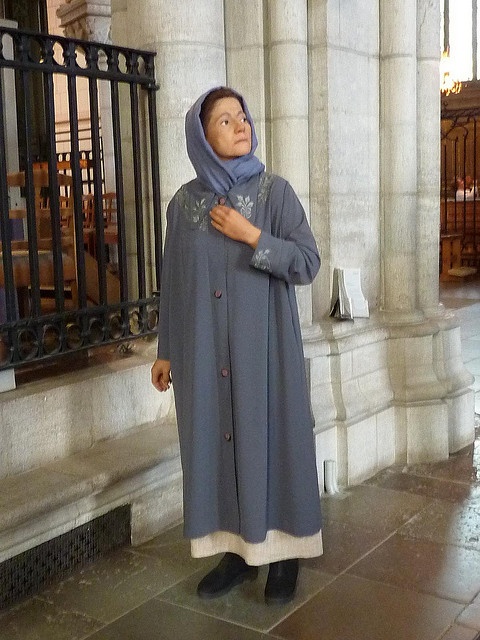
The “tourist” remained motionless for too long than is humanly possible. She is, I learned later, a remarkably lifelike, life-size reproduction of a woman, constructed of polyester, silicone, fabric, glass, human hair, and oils. Her hair partially covered by a blue shawl, she wears black boots, a blue coat with white floral embroidery, and a white skirt.

I looked at it from all sides and took pictures. A sign on the wall identifies, in Swedish then English, the name of the artwork: Maria (Återkomsten); Mary (the Return). The sign includes no commentary like the kind often seen in art museums, which explain the artist’s motivation or context.

In the gift shop, I asked what was the story of the life-like woman. The clerk said the space she gazed upon had previously been dedicated to Mary, the Mother of Jesus, until King Gustav claimed that space for his (eventual) tomb. I said, “I guess if you’re king, you can do what you want.” The clerk replied, “Or if you have enough money.”

The cathedral’s (former) Chapel of the Virgin Mary was dedicated to Jesus’ mother in the Middle Ages, but in 1550 King Gustaf declared that’s where he wanted to be buried. Ten years later, he died. Mary’s depictions and tributes were evicted, and the king’s tomb and tributes replaced them. After that, her presence in the church was minimal.

In the early 2000s the Cathedral announced a competition for art that would be a “visible reinstatement of the Virgin Mary inside the church.” The winning proposal, submitted by Swedish painter and sculptor Anders Widoff, was installed in 2005.  

Widoff’s Mary, which took him over six months to create, is not depicted as she often is in cathedrals: mother of Jesus, wife of Joseph, or surrounded by virginal, holy glow.

She stands alone, on the floor, not in an elevated position, as are paintings one has to look upward to see. There are no ropes or rails to keep tourists at bay, which makes the piece vulnerable to touch, which, over time, could degrade it. There are no candles or benches, as with artwork that invites meditation and reflection. She stands there, looking.

In an interview, Widoff said, “This is a woman who is quite small actually. She is forty, maybe forty-five years old and stands and looks over at [King Gustaf’s chapel], at the light over there. She is wearing an inconspicuous coat with a slightly oriental cut. I want her to look like you and me, kind of like if she were on her way to the store to buy bread.” He also said, “I wanted to see Mary as herself, as a woman first and not just in covenant with Jesus….” And: “[It] has been important to give her an independent role. She had a pretty troublesome son. It’s a way to give her redress and not just see her as a supporting character.” And: “I didn’t want to make her too beautiful, then it will be a distance.”

Liberation theologians point out something that should be obvious but wasn’t to me until I read their writings: That we all see things from our own perspective, which shapes and influences how we interpret and describe things. It’s a basic aspect of human nature, but before reading liberation theology, I didn’t think of myself as someone with familial, cultural, racial, and gender contexts that significantly (though not completely) shape who I am. These theologians are sometimes faulted for having a limited perspective, but one of their assumptions is that ALL of us have a limited perspective.

Here are some comments I found in an online search for others who interpreted “Mary (the Return)”:

            “a strange, small woman”

             “her shy gaze”

             “That Jesus’ mother has been placed in such a hidden place, so inconspicuous, feels as if she is being devalued, as if she has been placed in the corner of shame.”

             “…composed, and seemingly deep in prayer. I took her for a refugee.”

             “unassuming woman, quietly dignified and resolute, gazing unflinchingly towards the East window.”

             “Maria’s careworn look is emblematic of the suffering and courage of so many women around the world.”

            What makes her “strange” or “shy” or “resolute” or “careworn” or a “refugee”? Of course her gaze is “unflinching;” she’s a sculpture that can’t move.

            When I learned the backstory of this Mary, I recalled a movie I saw (I can’t recall the title. Help anyone?) in which a family was forcefully displaced from their home by aggressive forces, and they fled to another country. Years later, the father of the family returned to their home to find it occupied by a friendly young mother with a child. He visited her cordially and looked at rooms and spaces that evoked his family memories, without telling her it was his former home wrongly taken. The scene was powerful even without outrage that he could have righteously expressed.

            My thoughts that I projected onto Mary: She looks wistfully at her former “home” from which she was ousted by a powerful monarch. (Not even the mother of Jesus could stop that.) She used to belong there; now she doesn’t. But being drawn “home” is a strong human impulse.

I haven’t lived in Clinton, Mississippi for 45 years, having left after I graduated college in 1980. But I grew up there, and it still feels like home. My childhood and adolescence were steeped in the state’s culture, traditions, and many contradictions. In contrast with Mary’s former cathedral nook and the home of the returning refugee in the movie, the house in Clinton I return to is still occupied by my family, and when it no longer is, it will be because we sold it willingly—not because it was taken away.

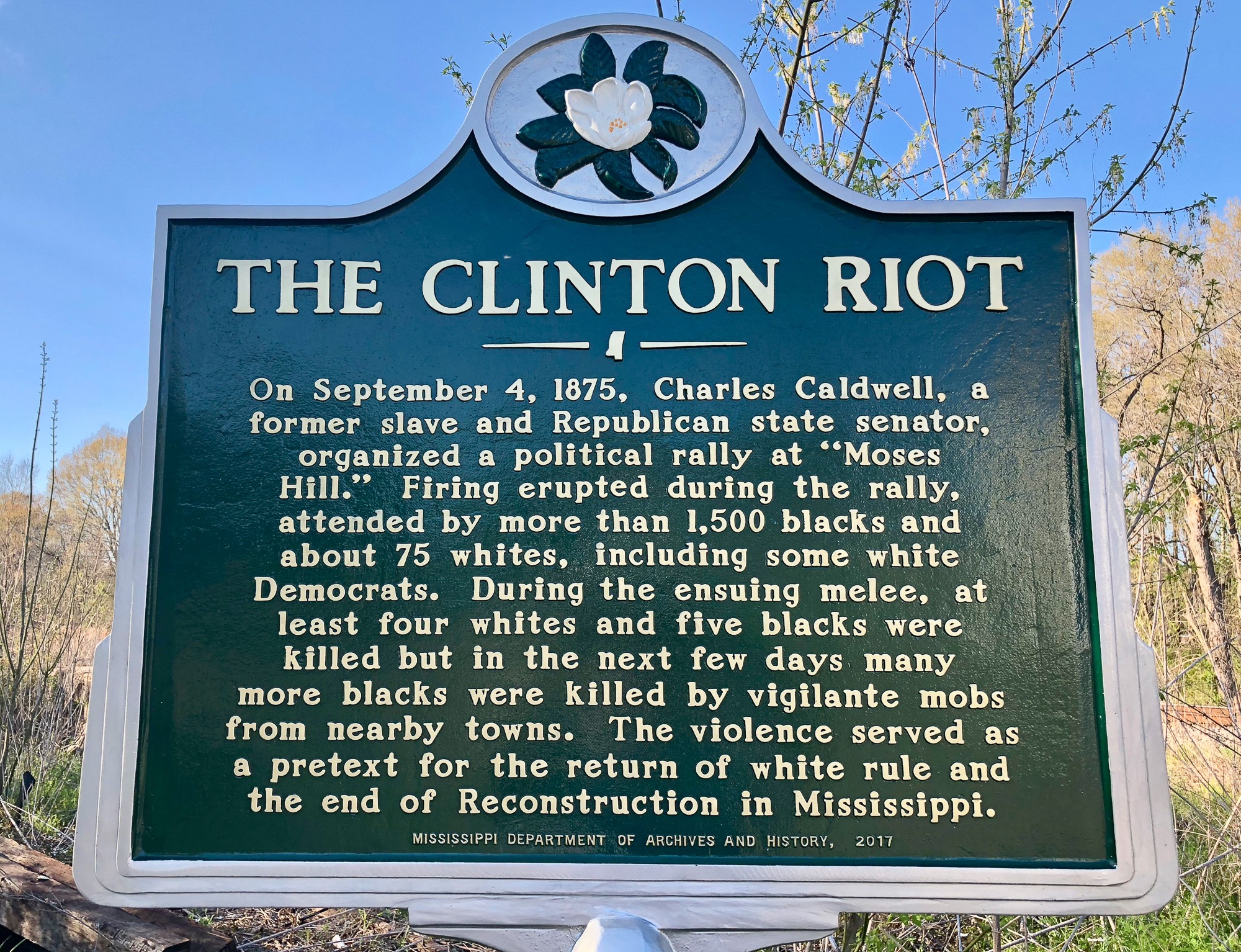
In the aftermath of the Clinton 1875 massacre, in which 50 Black and 3 White citizens were killed over 4 days, many Black Clintonians fled their homes and never returned. One of my ancestors, alas, led a contingent of the White marauders. “Home” is different for different people with different stories.

Welcome back, Mary. May the memories be sufficient.