Prison In A Hospital

March 2005

A 46-year-old resident in the 12-month Clinical Pastoral Education (CPE) program at Atlanta Medical Center (AMC), near downtown, I was training to become a healthcare chaplain. We provided spiritual care at the hospital, read assigned readings, wrote papers, attended group meetings with other residents and our teachers, and met with individual teachers. We wrote up accounts (“verbatims”) of chaplain encounters and shared those with residents and teachers, in order to receive feedback. Like medical residents, we learned as we worked.

I heard loud rapping on the chaplain office door, opened it, and met several people, who said they had been told their family member was at AMC in the Intensive Care Unit (ICU) and was brain dead and they better get there quick. They were breathing hard, looking at me eagerly, anticipating I could be helpful. I recognized the patient’s name. They said they thought a chaplain had called them, and I said I doubted it was one of us. He was in the  ICU section where I was the assigned chaplain, so if any AMC chaplain had called them, it would have been me.

I recalled that he was a federal inmate and looked up his information on the computer. I told them he had been there two weeks. Two of them fell to the floor in exasperation and anger. One exclaimed, “How could he be here that long and no one told us?”

I led them to a conference room outside the ICU and said I’d find out what I could. The doctor predicted he would be brain dead by the next day. He had just enough blood flow to his brain that he couldn’t yet be declared dead. Earlier that morning I had watched as the neurosurgeon tested the patient for responsiveness. He checked his pupils with a flashlight, pressed a sharp pointed instrument against the bottoms of his feet, among other tests. Nothing. He lay in the bed, handcuffed to the rail, motionless, eyes closed, breathing steadily, thanks to a machine.

I told the prison guard with the patient about the family’s arrival, and he said the prison never tells family that an inmate is hospitalized, for security reasons. I said apparently someone at the prison broke the rules and called the family. He shrugged his shoulders. I  wondered if  a prison chaplain had felt sympathy for the family and tipped them off. That would be a risky decision that could cost someone their job.

I explained to the family that, as far as the prison was concerned, the patient was treated the same as if he were still locked up, which meant he could have no visitors apart from the tightly controlled visitation process at the prison. They couldn’t walk up to the prison and request a visit, and, from the prison’s point of view, this situation was no different. He was a short walk away through double doors and down a hall, but the prison walls still kept them away. The patient’s mother, tears running down her cheeks, said, “Do you mean I can’t see my son before he dies?” I said I’d talk to the charge nurse, Julie L., and see what we could do.

She called the warden and explained what was happening. Given that the inmate’s family was at the hospital and knew he was there and given that he was on the verge of being declared brain dead and not an escape or trouble-making risk, they faxed over their list of approved visitors for this inmate and allowed only those on that list to visit—and only for that day. I escorted the ones on the list back and forth to the patient’s room, two at a time.

The family continued to be angry and I suggested they direct their anger at the prison, not the hospital, since we followed their rules. They threatened to call a detective they knew, TV news reporters, and a friend who knew Atlanta mayor Shirley Franklin. “Tell her I need her,” the patient’s mother said. “I know he done wrong, but this shouldn’t happen.” They were outraged, ready to expose an injustice.

I expressed empathy with their situation and said as taxpayers they had every right to hold the prison system accountable if they thought the policy was wrong. I said perhaps the prison could make an exception and inform family when an inmate is in this one’s condition.

After I said that, I wondered if I was pandering to them. It wasn’t exactly a spiritual thing to say (“taxpayers”?). It sounded more like lawyerly advice. But it may have helped establish rapport between me and the family. For chaplains, rapport is foundational to trust, which can lead to meaningful conversation, which is fertile ground for spiritual care.

In fact, I didn’t say much of anything “spiritual.” I didn’t offer prayer or Scripture reading. They had one overwhelming need: being present with someone they loved who was about to die. Injecting something “spiritual” seemed like something I needed to do to prove my ministerial worth—not something they actually needed. (In CPE, we learned to consider, when relating to someone, “Whose need is being met?”) Facilitating their visits was pastoral enough. They were able to be beside someone they loved, say their own prayers if they desired, and say a final good-bye. Making a deep human connection—and what is deeper than anticipating the death of someone next to you and reflecting on their life?—is spiritually healing.  

I was glad this happened while Julie was involved. In a prior incident, she had questioned my judgment. Now, she witnessed my competence: keeping the family calm, arranging orderly visits, and saving the nurses hassle. She and I interacted as colleagues.

In CPE, many residents, including me, were working on our “pastoral authority.” We asked ourselves such questions as:

***Will anyone find me helpful? Early in my residency, I would enter a room and introduce myself with almost an apology: “Hi, I’m Jerry. I’m the chaplain, but I’m here just to support you and listen.” My teacher put an end to that. He reminded me that I belonged there as part of the health care team, along with doctors and nurses.

***What if they assume I’m a stereotypical Baptist preacher and decline my visits without finding out otherwise? Once a gay man was in the ICU and during my initial visit, his partner arrived and, sounding perturbed, said he, as the patient’s appointed health care representative, had indicated he wanted no chaplain visits. Who knows what pain or rejection or ridicule they had faced from church people or ministers? This protective partner intended to prevent anything like that.

I of course agreed but also felt disappointed. I had no opportunity to explain that I wasn’t THAT kind of minister. My church welcomes gay folks and hosts gay marriages. Maybe that would have made no difference anyway, though. Explaining myself would have been more for my benefit, my self-congratulation. (“Whose need is being met?”) I was, like it or not, embedded in the world of “Christian ministry” and represented something they apparently needed to avoid. Their comfort and sense of safety may have demanded my absence, regardless of my openness and progressive theology.

***What if they WANT a typical Baptist preacher and are disappointed that I’m not?

Some staff complained about the family’s anger and threat to call a TV station, but I said I understood their emotions, and that they had calmed down appropriately once things were explained. In the end, the family and hospital staff expressed their appreciation to me.

Someone brought the patient’s 9-year-old daughter to the ICU hall, but, even though she was on the prison’s list of allowable visitors, I had to walk her back to the waiting room. The hospital’s policy didn’t allow ICU visitors under 12. I felt a twinge of regret as I thought of my own daughter, who was 6.

The patient’s grandmother arrived and asked if she could see him. She was not on the list, so I told her she couldn’t. Seeing disappointment in her face, I almost risked letting her in. The guard let me handle the gatekeeping and hadn’t been checking IDs, so he probably wouldn’t have noticed, but I didn’t try. If I had, I would have risked the forgiveness-not-permission tactic, but, instead, I followed the rules.

The patient’s 14-year-old daughter visited, and she commented that it was stupid that the unresponsive patient was still chained to the bed. Later, the guard pushed the chain under the sheet so it was less visible.

An AMC security guard met with the family, read the list of approved visitors, and said everyone else should leave the property since there was a large crowd (by then around 30 people) and since it was an “inmate situation.” Some family again expressed anger, but one, who had been a calm liaison between family and hospital, helpfully said that if they didn’t cooperate, no one would be able to visit. They grumblingly agreed and left. I finished taking the allowed visitors to the patient’s room.

The next day, a different guard stationed with the inmate told me he had heard a doctor say the patient was “gone,” and the guard had asked if the patient was dead, and the doctor had said, “Not quite.” Apparently, “not quite” only meant the machine maintained the patient’s breathing although he was in fact brain dead. That nuance didn’t register with the guard so when I later asked where we were, the guard said he had to hear from the doctor that the patient was dead, not just brain dead. Only then could someone come from the prison, fingerprint the patient, and declare him no longer an inmate. The nurse told the guard there was no difference between brain dead and dead, but he said he had to hear definitive word from the doctor.

The nurse paged the doctor, who told the guard the patient was actually dead. Until then, we were in this strange realm in which a dead man was still an inmate shackled to a bed.

I later told my teacher, Franklin D., who was also the director of the CPE program, about this incident, and he said he was glad I didn’t let the grandmother visit. If my deception had been discovered, he might have had to clean up a mess—because of me, a mere chaplain-in-training.

 Should I have risked my job and, possibly, the status of the program in the hospital, to be compassionate to the grandmother?

Should I have gambled that a visit by the 9-year-old daughter would have been unnoticed, or overlooked?

I was operating amongst three systems: the prison, the hospital, and CPE, each with their own interests and institutional ways of operating. The prison prioritized security; the hospital wanted to keep things calm and keep the prison’s business; CPE needed a hospital to train in. We navigate our lives among such systems that shape and prod and pull us. We are able to make individual decisions, but institutional, systemic forces are restrictive, powerful, and enticing. They shape us in significant and sometimes unacknowledged ways.

I had two primary interests: become a better chaplain and complete the program. Without CPE certification I would have been unable to get a chaplain job. So I didn’t risk my standing there. It’s possible there would have been no bad consequence for me if I had taken those risks; perhaps hospital administration would have appreciated my empathy for the family. But I didn’t feel confident to challenge these systems.

There is, however, a reason to think I would have been safe.

Julie herself had once skirted the rules out of compassion. Another unresponsive gay man in a coma in the ICU had a long-time partner, but as gay marriage had yet to be legalized and the couple had no written documentation of the partner’s medical decision-making authority, the patient’s parents—conservative Catholics ardently opposed to homosexuality—were legally the closest next of kin (Georgia has a chart outlining this hierarchy) and thus by default had medical power of attorney. They barred the patient’s partner from visiting him. Julie—in violation of hospital policy—allowed the partner to visit early in the morning before the patient’s parents arrived for official visiting hours.

Julie’s standing in the hospital was much more secure than mine. ICU charge nurse is a key position, and she was excellent. I’m sure she could have defended her decision and kept her job. (She may have even cleared it with hospital executives, I suppose.) So there is a way to navigate those systems with finesse. I was a chaplain resident with little clout, needing to complete the training, so I have an excuse in my pocket, but a part of me wishes I had had the savvy and insight to risk breaking those rules with guile, courage, and love.

Backyard Fire Pit

Take the time to sit and watch

Flickers dance in unpredictable directions

Scoot back if too hot

Forward if cool

Add wood

New wood flares, settles down to a smolder

Small pieces flame up and torch big pieces

They need each other

When big pieces lose touch with flame, we move them around

The fire needs us

Limbs small and large point outward randomly, then settle inward

Adding wood clears the yard faster than waiting on decay

Embers are a steady smoldering presence

Fade to gray overnight while we sleep

Ai Weiwei’s Arch

In Stockholm, between Nationalmuseum (the Swedish national gallery of fine arts) and the Nybroviken Bay waterfront, where tourists board and exit ferries and sightseeing boats, or sip a beer while enjoying the view, rises a gleaming stainless steel 40-foot tall arch.

Created by Chinese artist and human rights activist Ai Weiwei, the artwork, entitled simply “Arch,” resembles a cage with a curved top, its inner walkway shaped like a silhouette of two people embracing.

Many passersby stroll through that opening, amused by their images distorted by the curved, polished, shiny interior, reminiscent of fun-house mirrors that make us comically thin or wide, or weirdly misshape our heads. Children laugh, pointing at their goofy face—or Mom’s or Dad’s.

So it’s fun, but it also can be seen as two people ruining the purpose of a cage: trap people inside; keep outsiders out. The silhouetted figures didn’t merely escape the cage; they broke all the way through it. The shiny surfaces inspire literal and thoughtful reflection. One commentator referred to the “vulnerable gentleness in the curves of the cut-out figures.”  They went on, “The figures that hold each other at the centre of the sculpture, cut out of the bars, remind us of the basic values of equality, trust, empathy, and social responsibility for our fellow human beings.” An embrace is basic humanity, strength in the midst of struggle. Sometimes, it takes an accomplice to accomplish something.

Ai Weiwei, whose conceptual art can be bitingly—but often not overtly—subversive, is internationally praised but has been treated harshly by the Chinese government for criticizing their deficiencies regarding democracy and human rights. In 2011 he was arrested and held for 81 days without charge, generating international protest, then not allowed to leave the country for four years. He has since lived in Germany, England, and Portugal.

Ai Weiwei

After the 8.0-magnitude earthquake in Sichuan province in 2008, Ai led an effort to memorialize the names of over 5,000 children who perished in poorly constructed schools that collapsed, while many nearby buildings remained standing. For the 2013 Venice Biennale, Ai created an installation, entitled “Straight,” composed of 150 tons of twisted, contorted steel rebar clandestinely salvaged from the rubble of schools destroyed by that earthquake. Ai’s team hand-straightened each metal bar.

We happened to be in Venice that summer. The emotional power of the installation is hard to convey, unless you saw it. At first, it looked like a pile of discarded construction metal, but, after reading on an explanatory sign the source of the metal and that Ai was commemorating the lost children, we noticed the bars were arranged to evoke the undulating movement of ocean waves, or perhaps flags waving in the wind. (One of the few structures that remained upright at one of the earthquake-damaged sites was a flagpole topped by a windblown flag.) Waves can be soothing, flags patriotic, and this art turned those thoughts upside down. The mangled-then-straightened steel—visually, metaphorically—holds to account governmental corruption and neglect.

Such is the power of Ai’s art. He can evoke emotion and deep contemplation on the world around us. He creates work that defies the barriers of language. Both “Arch” and “Straight” combine art and activism.

According to Ai, “Arch” was originally about racism and the global refugee crisis caused by regional insecurity. Interpretations changed over the years as issues emerged, such as the U.S. immigration crackdown and the isolation created by the COVID-19 pandemic. Ai said in an interview, “Our world is more uncertain and unstable than any other time during the previous half a century. Against such a backdrop this work is once again a warning and reminder.” He said, “It’s more relevant to us as we all face the challenge of walking out of the cage of our thoughts, life conditions, and wars, to enter the state of peace and health.”

Ai said “Arch” calls for the free passage of all populations, and a world without borders. Like John Lennon’s “Imagine,” (“Imagine there’s no countries. It isn’t hard to do. Nothing to kill or die for… You may say I’m a dreamer, but I’m not the only one. I hope someday you’ll join us, and the world will be as one.”) it is idealistic and unrealistic, but provocative. “Arch” evokes visions of our shared striving for human connection, freedom, and peace.

“Art should be something that liberates your soul, provokes the imagination and encourages people to go further.” – Keith Haring, New York City graffiti artist

Keith Haring, Untitled, 1982

Mary Returns to See

I ambled through the cathedral in Uppsala, Sweden, down the middle aisle, then along a side aisle, toward the back, where I would turn right to walk between the main chancel and the rearmost chapel—a recessed semicircle at the eastern end of the cathedral, where the sun rises, which makes it symbolic of Jesus’ Resurrection and of spiritual renewal. Along the way, I admired and shot photos of artwork and stained glass. I took in the massive space’s sacred grandeur.

Making the turn, I almost said, “Excuse me.” I thought I had walked in front of a tourist, a lone woman who seemed to be looking intently at the sunlit ornate chapel.

The space she beheld has the remains of Swedish King Gustav Vasa (1496-1560), founder of the Vasa Dynasty and unifier of Sweden in the 16th century. Three stone effigies—his and on either side of him those of two of his three wives—all lie atop his sarcophagus, which was designed by Flemish artist Willem Boy. Seven frescoes on the curved wall depict scenes from the King’s life. Uppsala Cathedral is also the burial site for other royalty and famous Swedes.

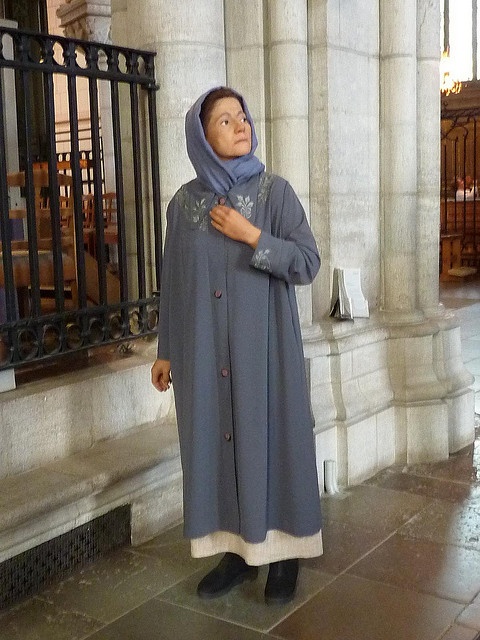
The “tourist” remained motionless for too long than is humanly possible. She is, I learned later, a remarkably lifelike, life-size reproduction of a woman, constructed of polyester, silicone, fabric, glass, human hair, and oils. Her hair partially covered by a blue shawl, she wears black boots, a blue coat with white floral embroidery, and a white skirt.

I looked at it from all sides and took pictures. A sign on the wall identifies, in Swedish then English, the name of the artwork: Maria (Återkomsten); Mary (the Return). The sign includes no commentary like the kind often seen in art museums, which explain the artist’s motivation or context.

In the gift shop, I asked what was the story of the life-like woman. The clerk said the space she gazed upon had previously been dedicated to Mary, the Mother of Jesus, until King Gustav claimed that space for his (eventual) tomb. I said, “I guess if you’re king, you can do what you want.” The clerk replied, “Or if you have enough money.”

The cathedral’s (former) Chapel of the Virgin Mary was dedicated to Jesus’ mother in the Middle Ages, but in 1550 King Gustaf declared that’s where he wanted to be buried. Ten years later, he died. Mary’s depictions and tributes were evicted, and the king’s tomb and tributes replaced them. After that, her presence in the church was minimal.

In the early 2000s the Cathedral announced a competition for art that would be a “visible reinstatement of the Virgin Mary inside the church.” The winning proposal, submitted by Swedish painter and sculptor Anders Widoff, was installed in 2005.  

Widoff’s Mary, which took him over six months to create, is not depicted as she often is in cathedrals: mother of Jesus, wife of Joseph, or surrounded by virginal, holy glow.

She stands alone, on the floor, not in an elevated position, as are paintings one has to look upward to see. There are no ropes or rails to keep tourists at bay, which makes the piece vulnerable to touch, which, over time, could degrade it. There are no candles or benches, as with artwork that invites meditation and reflection. She stands there, looking.

In an interview, Widoff said, “This is a woman who is quite small actually. She is forty, maybe forty-five years old and stands and looks over at [King Gustaf’s chapel], at the light over there. She is wearing an inconspicuous coat with a slightly oriental cut. I want her to look like you and me, kind of like if she were on her way to the store to buy bread.” He also said, “I wanted to see Mary as herself, as a woman first and not just in covenant with Jesus….” And: “[It] has been important to give her an independent role. She had a pretty troublesome son. It’s a way to give her redress and not just see her as a supporting character.” And: “I didn’t want to make her too beautiful, then it will be a distance.”

Liberation theologians point out something that should be obvious but wasn’t to me until I read their writings: That we all see things from our own perspective, which shapes and influences how we interpret and describe things. It’s a basic aspect of human nature, but before reading liberation theology, I didn’t think of myself as someone with familial, cultural, racial, and gender contexts that significantly (though not completely) shape who I am. These theologians are sometimes faulted for having a limited perspective, but one of their assumptions is that ALL of us have a limited perspective.

Here are some comments I found in an online search for others who interpreted “Mary (the Return)”:

            “a strange, small woman”

             “her shy gaze”

             “That Jesus’ mother has been placed in such a hidden place, so inconspicuous, feels as if she is being devalued, as if she has been placed in the corner of shame.”

             “…composed, and seemingly deep in prayer. I took her for a refugee.”

             “unassuming woman, quietly dignified and resolute, gazing unflinchingly towards the East window.”

             “Maria’s careworn look is emblematic of the suffering and courage of so many women around the world.”

            What makes her “strange” or “shy” or “resolute” or “careworn” or a “refugee”? Of course her gaze is “unflinching;” she’s a sculpture that can’t move.

            When I learned the backstory of this Mary, I recalled a movie I saw (I can’t recall the title. Help anyone?) in which a family was forcefully displaced from their home by aggressive forces, and they fled to another country. Years later, the father of the family returned to their home to find it occupied by a friendly young mother with a child. He visited her cordially and looked at rooms and spaces that evoked his family memories, without telling her it was his former home wrongly taken. The scene was powerful even without outrage that he could have righteously expressed.

            My thoughts that I projected onto Mary: She looks wistfully at her former “home” from which she was ousted by a powerful monarch. (Not even the mother of Jesus could stop that.) She used to belong there; now she doesn’t. But being drawn “home” is a strong human impulse.

I haven’t lived in Clinton, Mississippi for 45 years, having left after I graduated college in 1980. But I grew up there, and it still feels like home. My childhood and adolescence were steeped in the state’s culture, traditions, and many contradictions. In contrast with Mary’s former cathedral nook and the home of the returning refugee in the movie, the house in Clinton I return to is still occupied by my family, and when it no longer is, it will be because we sold it willingly—not because it was taken away.

In the aftermath of the Clinton 1875 massacre, in which 50 Black and 3 White citizens were killed over 4 days, many Black Clintonians fled their homes and never returned. One of my ancestors, alas, led a contingent of the White marauders. “Home” is different for different people with different stories.

Welcome back, Mary. May the memories be sufficient.

Be A Good Sport

Here’s how sometimes life throws you a curve: I don’t play golf, but I have “golfer’s elbow.”

That’s the way the ball bounces. You can’t win ‘em all.

I’m going to step up to the plate and not pull any punches and say: Someone dropped the ball in naming that condition. Whoever did so may talk a good game but didn’t keep their eye on the ball.

Perhaps by naming lateral epicondylitis as “tennis elbow,” they thought they hit a winner, knocked it out of the park, made a gutsy play, and were in a league of their own, but this time they missed a chip shot. A gimme. Couldn’t buy a basket. Made an unforced error.

Maybe there were off-field distractions.

To whoever tossed this misnomer: The ball’s in your court. You’re on the hot seat. So maintain your composure, get your head in the game, fire on all cylinders, and get back on track. Oh, and give 110%.

Stranger things have happened.

The Alphabet Helps Save My Soul

I get bored in church.

A lifelong church addict, son of a preacher man, confessing, I feel relieved, unburdened.

I do not, however, attend a boring church. Neither of my pastors preaches boring sermons. They research wisely, tell good stories, are often funny, and challenge us to live faithfully in all parts of our lives. We in the pews are stimulated emotionally, intellectually, and spiritually.

We have creative services that include laypeople who express the gospel in myriad ways. Dancers dance; poets recite; actors act. Singers sing, sometimes songs one wouldn’t expect to hear in a church. We have had services with themes ranging from humor-as-grace to depression to righteous anger to “breaking up” Christmas—a service inspired by an Appalachians-partying-for-several-days tradition; it ends with a conga line snaking through the aisles.

If I’m bored, the problem is me.

Maybe I have SADD: Spiritual Attention Deficit Disorder.

Regardless how interesting a service might be, my mind scampers. I might think about a movie. Wasn’t that actor what’s-his-name, the same one in that whatchamacallit movie? Then I’m back to the sermon, urging myself to pay attention, then I’ve floated off to the movie. Or a photography exhibit at the High Museum of Art. That picture with the bridge and all those shadows was intriguing. Or what I should and shouldn’t put in our compost pile. Should I rinse the egg white residue out of the eggshells—to avoid attracting rats? I think of what I need to do that week, that afternoon, what I did last week, what I wish I had done last week.

Oh, look, Dolores has a new hair ribbon. Or did she wear it on Easter?

Once, out of some obligation that I can’t recall, I invited someone for dinner that I didn’t really want to share dinner with. The invitee said they couldn’t make it, and, instead of relief, I wondered: What’s wrong with me? Am I not likable? Did I offend them? Likewise, I felt bad about my bored-in-church problem until I devised a way to defeat (well, lessen) it: the alphabet.

I listen for words in the sermon that contain the letters of the alphabet, in order. When the sermon starts, I listen for a word that contains the letter “A.” If the preacher says, “Following Jesus means…,” I note  the word “means,” then listen for a word that includes the letter “B,” and so on. The game usually breezes along until I reach “J,” not among the most commonly used letters, but since we’re Baptists, we fawn over Jesus, so “J” eventually appears–if not in “Jesus,” then “joy” or (in my progressive church) “justice,” or, if it’s Advent, possibly “Joseph,” although he is overshadowed by Mary and the Christ child.

“K” may take a bit to appear, but the real next snag (or, as my Mom likes to say, “bugaboo”) is “Q.” That letter is shackled by usually requiring a partner (“U”), so it doesn’t pop up willy nilly like, say, “E” or “T.”  Fortunately, my church, instead of hammering away at the fundamentals of the faith, encourages “questioning.” It is a well-educated congregation, so I may hear fancy words like “quintessential.” Or “acquiesce,” as in, “Don’t acquiesce to temptation.” Or, since we’re a church that “welcomes and affirms” gay people, “queer.” The preacher might say a biblical story is “quite inspiring.”

If I hear a “Q” when I need one, I usually slide on through until I reach the last three letters: “X,” “Y,” and “Z.” “Y” is common, but not “X” and “Z.” I will hope the preacher says she has an “example” to illustrate the message, or that a peculiar passage of scripture (there are quite a few, you’ll discover, if you look), is “vexing.” Maybe she’ll refer to something in the “text,” a word academically trained folks are prone to use about the Bible.

By this point, the sermon is usually near the end, and if I advance past “X” and “Y,” my fingers are crossed as I hope, in the little time left, the preacher says the selected passage of Scripture has made her “realize” something. Or something she saw or read was “amazing.” (We don’t talk much about “evangelizing” in my church, alas.) Whenever “Z” does appear when needed, I celebrate, then start over at “A.”

That almost never happens.

Often, I never get past “Q.” If I do, I’m lucky to later hear an “X,” and it’s a miracle if I hear a “Z” at the right time. I wince when I hear “Q” or “Z” words early in the sermon, before I need them. “Quizzical” too soon? That’s a killer.

This game (in addition to helping me overcome boredom) helps me listen to sermons. Hopeful for the next letter, I follow the words closely. If there’s an inspirational point in there somewhere, I’m bound to notice.

FYI: A preacher could thrill me by sermonizing this: “A beacon to redemption for good heroes of faith is Jesus, who kindles many open questions that raise touching visions that reward excellent ways of being spiritually ablaze.”

I might shout, “Amen!”

Which is a start.

The Tao of Scrabble (apologies to Benjamin Hoff)

Drawing the face-down lettered tiles—unless you cheat—is random. So sometimes you get a bad hand. Keep playing. 

Blank is valuable. 

Think beyond the immediate move. 

Sometimes, gain less now to gain more later. 

Versatility matters. 

That which pairs well with another gains much. 

Using many letters is often less valuable than using fewer. Unless you play all your letters and make a fresh start. 

Letters huddled together pack a wallop.  

It’s not only what tiles you play that matters but what you leave behind. 

You need both vocabulary and math. 

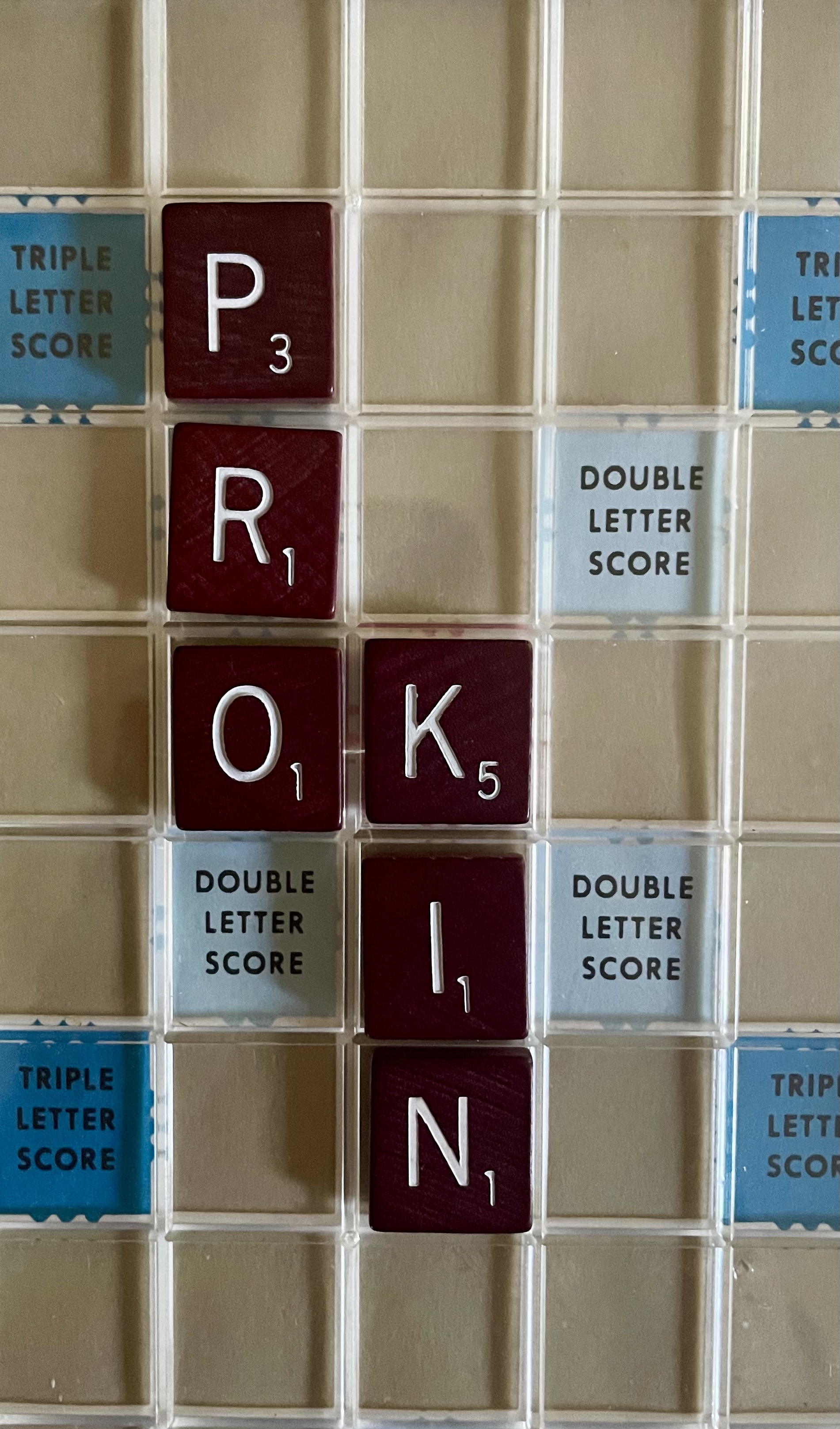
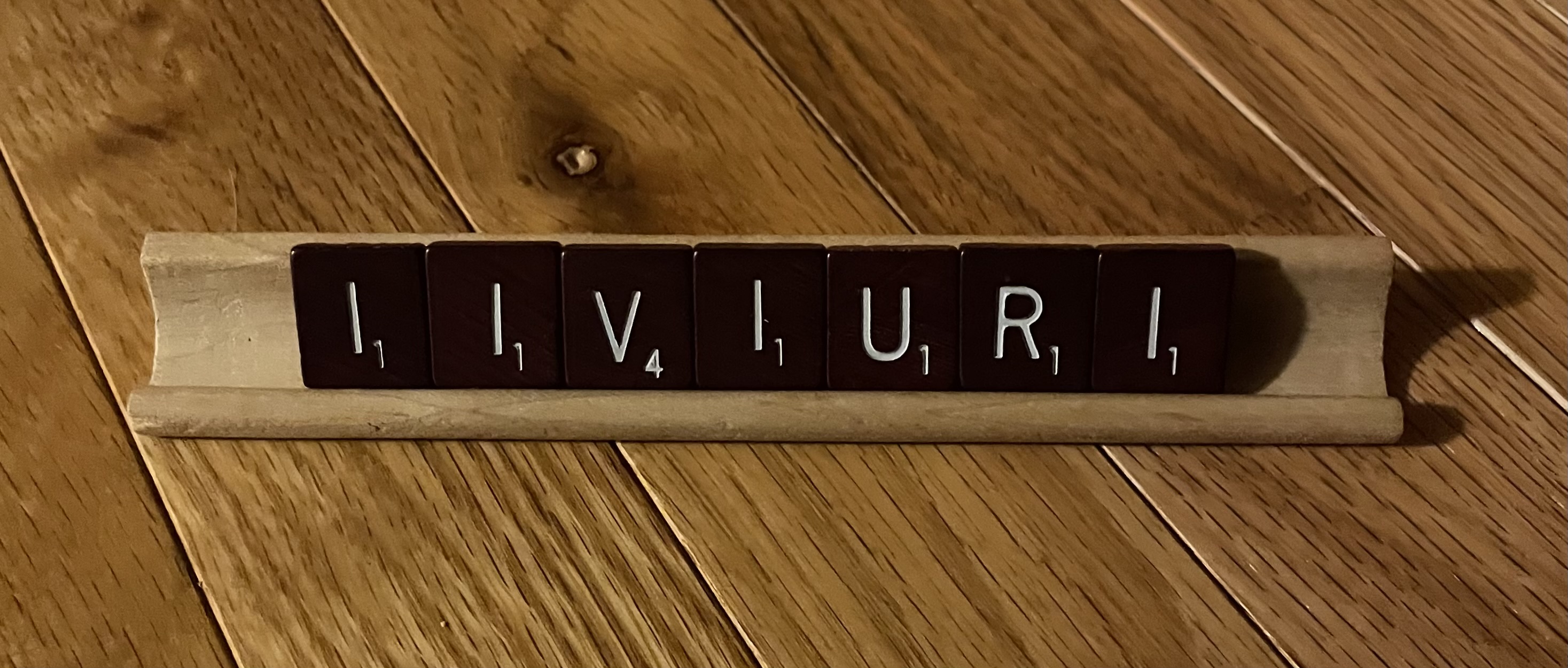
Too many i’s makes play difficult. 

Sometimes it’s ok to take a deep breath and concede a game that has become unwinnable. It happens. There will be another one.

Cathedrals: Enormous Sacred Space

The cathedral  in Freiburg, western Germany, much like the Packers’ Lambeau Field in Green Bay, Wisconsin, looms vastly out of proportion to the city around it. Both cities have modest populations but enormous edifices that dwarf surrounding buildings and attract gawking tourists from around the world. Both have statues of revered figures. You can pay to tour them both. One is overtly religious; one may as well be.

View from Frieburg Cathedral Spire

Construction on the Freiburg cathedral started around 1200 in the late-Romanesque style (towering round arches, massive stone and brickwork, small windows, thick walls) and was later finished in the Gothic style (pointed arches, stained-glass windows, flying buttresses, ribbed vaults, and spires). Its construction took over 300 years, so most builders and designers never saw the finished structure.

Its most prominent feature is the 380-foot tall ornate spire, the first spire in the history of Gothic architecture built with open lattice. Bottom to the highest viewing platform open to tourists is 335 steps.

Looking Up Inside the Spire

Among the cathedral’s 19 bells, 16 of them in the tower, the oldest and most famous is the 750-year-old, 3-ton “Hosanna bell,” one of Germany’s oldest Angelus bells, which are rung before the traditional Catholic Angelus prayer service (a celebration of the Incarnation of Jesus) and each year on 27 November in remembrance of fierce Allied bombing raids in 1944. The Hosanna’s ring is said to be “unmistakable: melancholic, loud, and clear.”

The cathedral survived the air raids, which left nearly all of the old part of the city around it in rubble. The tower vibrated violently but held firm due to the secure lead anchors firmly binding its sections. The windows had been removed from the spire prior to the bombing and also suffered no damage. It is built to last.

The cathedral has one of the world’s largest “Lenten veils”  (also known as “fasting cloth”), at 10×12 meters. It was created in 1612 and features a large painted Crucifixion scene. The largest in Europe, it has been displayed for the last 400 years from Ash Wednesday until Holy Wednesday (which commemorates the Bargain of Judas as the betrayer of Jesus—also called Spy Wednesday). It was customary in Europe during the Middle Ages for the veil to completely separate the main altar (chancel) from the rest of the church. Some say that placement was for the congregation to focus on listening as they could not see the liturgy being performed—a form of “visual penance”—to remind Christians of their sinfulness and to encourage repentance. See no liturgy, sense your guilt. Nowadays, Lenten veils are utilized in some parts of Austria and Germany, more to indicate the beginning of Lent and less to block the view of the chancel. In 2003, the Freiburg Lenten cloth was repaired and given a supportive backing and now weighs over a ton. Moving it requires special machinery.

The cathedral’s high altar features a multi-panel painting by prominent German Renaissance artist Hans Baldung, who created altarpieces for many cathedrals. (He was also infamous for painting scary witches in forests casting evil spells, which contributed to witch hunts in the 16th and 17th centuries.) The altarpiece and the cathedral itself are dedicated to the Virgin Mary.

External masonry features, such as gargoyles (there are 91), are damaged by weathering and pollution, so the cathedral is a continuous repair site. One gargoyle bows toward the building and points its rear end at the city council building, and, according to a legend, was created by a disgruntled stonemason who was not paid the amount he expected by the council, which is forever saluted rudely. There is a spout for water to pour downward where you-know-what would be excreted from that part of an actual person. Next to it is one with its head leaned forward, buried in a book, a drainpipe emerging from the top of its head. Gargoyles direct water away from the building and were thought to ward off evil spirits—which, according to the city’s website, “is why many of these eerie creatures are depicted with tortured, screaming mouths.” (One theory is that the mooning gargoyle keeps the devil at bay with its outward facing posterior.)

According to an economic analysis of cathedral building, in the years 700-1500, such construction was “the expression of many impulses: religious, economic, political, artistic and cultural…. They required enterprise, planning and organization of a high order, substantial inputs of capital and labour (skilled and unskilled), and assemblage of impressive quantities of resources – stone, brick, lime and sand, timber, iron, lead, copper, glass and much else…. Prosperity and confidence in the future were good for church building.”  Economic good times featured robust cathedral construction, and technological advancement brought new features, plus more jobs and income.

Even in the religious realm, size matters. A cathedral, the bishop’s home church, is often a town’s most imposing building and one of its most ancient. It’s the central church of a diocese, indicative of the bishop’s high status in the hierarchy and is larger than parish churches led by mere priests. The large, prominent bishop’s chair is situated above both laity and other clergy.

Cathedrals are there for God’s (and the bishop’s) glory but are woven into the secular community around it. Cathedrals attract tourist eyeballs (like mine) and money. In the bustling courtyard surrounding the Freiburg cathedral, vendors sell art, crafts, souvenirs, and clothing. Restaurants serve diners on nearby streets. Cathedrals have served as sites for the staging of non-religious events, such as coronations, and as tombs for princes. Some display trophies celebrating state power, like the griffin atop the east gable of the cathedral of Pisa, a large gilded bronze statue of the mythical beast created to memorialize naval victories in the Western Mediterranean.

I felt appropriately awed by European cathedrals, their spacious interiors and massive building materials. How, without modern equipment, did they elevate impossibly heavy stones and bells so high? Meticulously crafted and brilliantly colored stained glass windows glimmered. I admired artwork by famous painters, as if in a museum. Cathedrals felt like special spaces: human ingenuity, wealth, and strength commandeered to foster awe of the divine.

Yet I also felt like an outsider. While I have stretched beyond my Christian origins to appreciate beliefs and practices different from mine and while I felt the sacredness of each cathedral, the Mississippi Baptist inside me lurked. In my formative years, church buildings were almost irrelevant. We wanted them to keep the rain off, look nice, and function well (I really wished my church had a gymnasium), but a painting by an accomplished artist would have been a distraction from focusing on Jesus. That kind of money could send missionaries to spread the Gospel in a far-off land. Our stained glass windows were mass produced, plain, with no interesting designs, ordinary collages of colors. We valued solid construction, comfortable pews, and reliable air conditioning (think Mississippi in July). The building was valued mainly according to whether it allowed heartfelt worship to happen inside it.

A gargoyle? That would have been too close to a pagan idol. Psalm 115 says idols are useless and deceptive, and #1 of the Ten Commandment warns against creating a “carved image” and tersely declares God is “a jealous God, visiting the iniquity of the fathers on the children to the third and the fourth generation of those who hate me.” Who wants to risk jealousy-driven iniquity on their grandchildren and great-grandchildren?

Of course, we Baptists have our own style of hierarchy and ways of exerting power (often while feigning humility), but my church didn’t enshrine status in the architecture. The pastor (my father) didn’t even have a reserved parking spot, much less his own perch above the congregation.

What counted for us was this: Was Jesus your Lord and Savior? Had you genuinely—not because everyone else in your town did or because your parents hoped you would—invited Jesus into your heart? You could do that anywhere, in any structure, religious or not, or while swimming in a pond. If you hadn’t, you were bound for eternal torture in hell and your life had no meaning (even if you thought it did).

I grew up prejudiced against formal, liturgical worship styles commonly used in cathedrals—with their pre-written prayers and historical statements of faith. To us, prayers had to be spontaneous or they weren’t genuine. In my provincial mind, “liturgy,” with its whiff of rote recitation, was alien to inspirational worship. Only later did I appreciate how liturgy can express holiness and reverence, can remind us of the mystery of faith, that there are things we can’t explain, yet we live faithfully anyway.

I visited the cathedrals more for historical and artistic reasons than religious. I can’t say I felt very spiritual in them.

Until something happened at the fabulous Strasbourg cathedral, the Cathédrale Notre-Dame-de-Strasbourg.

Strasbourg Cathedral

For 227 years, it was said to be the tallest building in the world and is now the world’s sixth tallest church. Hundreds of exquisite sculptured figures with fine detail cover the front façade, depicting scores of biblical scenes and other significant religious events, such as the martyrdom of Saint Laurent (allegedly, for insulting a prefect). The color of the exterior’s reddish-pink sandstone changes according to the time of day and the color of the sky. Like that of Freiburg, its towering spire is elegant and intricate. Its Renaissance astronomical clock (its mechanism dates from 1842) features a parade by the apostles every day at half past noon. The place is a marvel.

I wandered the interior taking pictures and admiring. I watched—and photographed—people lighting candles. The usual splendid features—altars, paintings, sculptures, architectural designs—impressed, as intended. I barely noticed the actual worship service at the front, until I ambled closer.  The front pews were packed with young adults, which seemed unusual. There was a palpable energy I didn’t associate with a staid, ornate cathedral. When the service ended, a security guard efficiently—and firmly—escorted everyone away from the front.

My German friend Andrea and I walked outside where we were surrounded by the crowd of young adults who had been at the front of the cathedral and had exited around us. They spontaneously  began singing songs of praise. Andrea, who speaks French, asked someone about the gathering, and she was told it was the culmination of a multi-day pilgrimage. They had walked from town to town, ending in Strasbourg, along the way attending spiritual meetings to deepen their faith, to experience, as they told Andrea, “the joy of the Lord.”

Joyful indeed, they smiled and hugged, celebrating the journey’s end. The singing was full and exuberant, their ebullient mood infectious. There was no energetic or frenetic shouting that I associated with Protestant charismatic worship. It was a measured exuberance. This time, being present at a cathedral—an ancient structure that I mostly associated with secular history and practices foreign to my Baptist roots—stirred my spirit. Next to the old gigantic stones, my heart was warmed. I cried tears of fond memory. The fervent faith of youth can be naively hopeful and sunny (pray and the world will bend to your prayers), but it also can be inspiring. The Spirit punctured through my assumptions and experiences, and touched me.

There ain’t no way we’re going to play this game

The day before Georgia Tech faced the Air Force Academy Falcons at Falcon Field in November, 1978, was sunny and clear, in the 50s. Tech radio engineer and producer John Kramer toured the campus on that gorgeous day, the eastern edge of the Rocky Mountains in sight, most spectacularly Pikes Peak. “We toured the fieldhouse,” he said “which blew me away, then the huge cathedral.” Designed with spaces for several religious traditions, the cathedral, a popular Colorado tourist attraction, features seventeen 150-foot-tall, glass and aluminum spires that jut dramatically to the sky. Sunlight filters through colorful stained glass. Granite front steps lead to glistening aluminum doors with a golden finish. Kramer, a former Air Force cadet, said, “It was stunning and beautiful. I was so damn proud.” He strolled the campus with no thought of the weather.

Tech head coach Pepper Rodgers, an Air Force quarterbacks coach early in his career, warned players not to look past the 3-6 Falcons to season-ending contests against formidable foes Notre Dame and Georgia. Military academy teams play hard and intelligent football, are disciplined, and won’t give up. He said they will have plenty of oxygen on the sideline to cope with the thin-air altitude of 6,035 feet (compared to Atlanta’s oxygen-rich 738). Constitution reporter David Davidson said when he walked from the press box down to the field, he had to pause to breathe deeply. Eddie Lee Ivery felt it, too. “I couldn’t get my breath,” he said. (According to Air Force assistant coach Dick Ellis, that’s what the home team wanted. When the visiting team left their locker room to enter the field, an ominous sign declared, “Welcome to Air Force, Altitude 6,035 Feet.”) Tech were well prepared for the conditions, Rodgers assured them.

Tech radio color commentator Kim King settled into his hotel room then went for a jog, admiring the Rockies, and thought, “Tomorrow is going to be a beautiful football day.” Trainer Ken Smith recalled flying to Denver and switching to a small plane. The pilot said not to worry about the Colorado Springs weather. A pilot would know, right? When Tech conducted Friday’s walk-through on the field, Rodgers chatted with Ellis and commented on the sparkling weather. Ellis warned him the weather sometimes changes drastically day to day. Rodgers joked, “Don’t you let any bad weather come in tomorrow.”

However prepared Tech players thought they were, their reaction Saturday morning was bewilderment that they were even going to play. Many—nearly all from the South—thought: They’re going to cancel this game. Lawrence Lowe said assistance coach Norm Van Brocklin said, “They won’t play in this weather.” Ivery said, “I didn’t think we would play either. We looked down on the field from the hotel and saw sweepers scraping a foot of snow off the field and I thought, ‘There ain’t no way we’re going to play this game.’” The machines were deployed twice before the game and again at the half, according to a media report.

Upon awakening, King was shocked see snow driven horizontally by a strong, howling wind, and, he recalled, a foot of snow on the ground. He called Tech play-by-play announcer Al Ciraldo and asked if he had brought sufficiently warm clothes. Neither had, so they drove to Kmart and bought gloves, hats, coats, sweatshirts, and thermal underwear. A Tech equipment manager scrambled to find heaters for the Tech sideline and thermal underwear for the players.

Kent Hill recalled the coaches saying, “The cold is all in your mind,” but Hill noticed the coaches wore extra clothing to keep warm. It apparently wasn’t all in their minds.

“It was so damn cold,” Donnie Sewell remembered, still finding it hard to believe. “I’m from Florida, and I was out there on that frozen field.” Gary Lanier said rags hanging from their belts froze when they got wet. Mike Kelley said with his fingers frozen and the ball rock-hard, “It was painful to take the snap.” Rodney Lee said, “Your hands were like stones and the ball was like a brick. My feet were completely numb. I had no feeling in my toes.” Rodgers’ fifteen-year-old son Kelly traveled to the game and said, “That was the coldest I’ve ever been. The cold is all you thought about. That field was like cement. I kept thinking when they get hit and fall to the ground, that’s gonna hurt.”

When Air Force assistant coach Tom Backhus saw the weather, he assumed the cadets could handle the cold but there was “no way these southern Georgia peaches are going to play well. No way. We thought we had an advantage and Ivery wouldn’t run well. But he killed us.”

Kelley’s family traveled from California. They may have wished they had stayed home. “They stayed the whole game,” he said. “They froze their patooties off. My grandpa was out there. They were covered in blankets. It was brutal.” Also shivering in the stands were representatives of the Tangerine Bowl, held in Orlando, Florida. Average afternoon temperature in November: 78°.

Tech defensive end Lance Skelton said he couldn’t feel his fingers and toes. When he exited the field to the sidelines, someone draped a big coat over him, but, he said, “The coats were frozen. It was like covering yourself in ice. We were miserable.” Marvin Dyett said one player was bleeding but didn’t know because his fingers were numb. According to Lowe, Van Brocklin told them to keep their feet warm by putting on a sock, wrapping it in plastic, then putting on another sock. But the feet of some players began to sweat, which froze.

 Air Force defensive back Charles Shugg said, “It was the coldest game I’ve ever played. It was a penetrating cold. We were used to being in cold weather, but it was so cold there weren’t many fans in the stadium. We were wrapping our feet in Saran Wrap inside our shoes, but the defensive backs coach was old school. He wouldn’t let us use heaters or gloves. We wore extra T-shirts, but that’s about it. It was brutal.”

Non-football-player cadets were required to attend games and to wear jackets and ties, regardless of the weather. They could wear an overcoat but not heavy-duty cold weather gear that a day like that called for, and, up in the stands, they were more exposed to the wind than players below. To ease their misery, they rotated in and out of the heated bathrooms.

Air Force linebacker Bill Becker was injured and watched the game from the sidelines, almost wishing he were playing to generate some heat. He said. “It was cold to just sit.” On the other hand: “For the guys on field, it hurt even more to be hit or to hit somebody. The turf was unforgiving. It was like falling on concrete. We kept thinking, ‘Can we have this over with now?’” Air Force fullback Steve Drewnowski said, “It was the coldest game I ever played. You’d put your hands down to the ground and your fingers almost get frost bite.” The only time he recalled being colder: when he flew scientists to Antarctica. Offensive coordinator Ken Hatfield said he gave gloves to backs and receivers, who removed them because they couldn’t feel anything anyway.

Jim Bowman, Director of Recruiting for Air Force, who had experienced twenty winters in Colorado Springs, watched the game from the press box. “It was terrible,” he said, “the worst weather I remember, and we had some bad weather. I was thinking, ‘Are you kidding? Are we playing in this?’”

King performed his usual pre-broadcast ritual: walk on the field to see the view from the ground and take in the atmosphere, to help him convey the scene to the radio audience. The ground was frozen. The fierce wind stung his eyes. He slid his feet gingerly to keep from slipping. He walked about 15 yards and thought, “This is ridiculous.” He reported to Ciraldo back in the press box, “It’s going to be hard to run or pass. I bet it’s a 3 to nothing game. The first team to kick a field goal wins.” He was unimaginably wrong, and footing actually turned out to be no problem. Ivery said the ground was slippery before the game, but after the snow was cleared, cleats were able to grip the turf fine.

Reports on the amount of snowfall were inconsistent. Some media said there was a light snow, but at least one newspaper reported the snow removal equipment could barely keep up with the snowfall. Herrington recalled snowplows removing snow before the game and snow blowers clearing off the line markers at halftime. Some players described lots of snow. (Not Drewnowski, who said, “I don’t think it snowed that day. I’m from New England. That’s not really snow.) Rodgers’ son Kelly said there was only “a remnant of snow.” Matt Rank recalled only snow flurries. Media pictures and one brief video clip from the game show little snow on the field. Perhaps there was snow piled up off-field and out of camera view? The National Weather Service archive shows no snow all week and only .6” on gameday. Perhaps memory of a dreadfully cold day exaggerates the amount of snow. Whether because the snow had been removed or little actually fell, what made the players miserable and sapped their motivation was the freezing temperature, rock-hard turf, and strong, vicious wind. When the game started, it was 20°, and the whipping wind made the wind chill factor zero. Or thereabouts. One Denver reporter wrote that the wind chill factor was 20 below. Not true, but nobody there would fault him for exaggerating.

But Air Force had a bigger problem than weather: Eddie Lee Ivery. Sewell said, “We kept running the same damn play, and they couldn’t stop him.” Air Force quarterback Dave Ziebart, who said it was “the worst weather in my four years at Air Force,” said of Ivery “I knew a lot of tough guys there, but he played just as well in the fourth quarter as early in the game.”

And Ziebart didn’t know about the throwing up.

“You Have One Now”

It’s almost impossible to exaggerate how much Bart Starr was adored and admired in Green Bay. Not merely a Hall-of-Fame superstar and 2-time Super Bowl MVP who led the Packers to 5 championships, Starr—a devout Christian who supported many charities—engendered a mythology of greatness and saintliness. He had championship rings—and a halo. Almost everybody in tiny Green Bay had a heartwarming Starr story: words of encouragement, acts of kindness, patience with autograph-demanding fans.

One man came to Starr’s home, where Starr was meeting with a coach, wanting an autograph for his father, who waited in the car, and, over the man’s objections, Starr left the meeting to chat with the enthralled fan.

Another said: “I met Bart in Milwaukee, and he said, ‘Next time you’re in Green Bay, drop by for a Coca-Cola.’”

(Everyone called him “Bart.”)

“My brother was driving over the river bridge, and it was 20 below, and his car broke down, and the first one to stop to help was Bart.”

And on and on.

Players and colleagues over many years uniformly used variations of one phrase to describe him: “He was a fine human being.”

          After Starr’s glory seasons as a player, the Packers suffered years of embarrassing mediocrity. The city’s moniker, “Titletown,” became a mocking taunt. Despite Starr having no head coaching experience, a powerful movement grew in Green Bay for the Packers to hire Starr. Citizen-by-citizen, Packers fans collectively decided Starr, whose coaching experience was only 1 season as Packers quarterbacks coach (1972, when they won the division—a faint sign of hopefulness), could translate his championship aura and quarterbacking-on-the-field success to on-the-sidelines coaching success and restore the quaint town’s tarnished image. The slogan “Fresh Start With Bart” proliferated all over town: bumper stickers, handmade signs fluttering in Lambeau Field stands. It was everywhere.

One fan said, “He was a smart, take-charge guy. We assumed he was everything we needed in a head coach. I thought his lack of experience would be overtaken by his status.”

Another fan said, “We thought the football gods would smile on us.”

Packers historian Cliff Christl said, “That was almost a case where the fans hired the coach.”

The Packers executive committee, according to former Packers historian Lee Remmel, “felt they had no choice because there was so much groundswell of enthusiasm.” The executive committee was a small group selected from the Packers board of directors, and it ran the team, along with the president, whom they chose. They were all members of the Green Bay community and routinely interacted with these avid Bart Starr-endorsers. In line at the grocery store, one might get a nudge from behind: “You’re going to hire Bart, right?”

All of Starr’s close friends advised he decline the offer, citing his inexperience, his promising business pursuits, and the difficulty of the risky job. But, deeply loyal to the team that let him rise from lowly 17th-round pick to 5 championships, he said, “They could have cut me, and they didn’t.”

Starr was named the Packers head coach on Christmas Eve, 1974. In a photo of that announcement, on the wall behind him and his wife, both smiling broadly, were banners that featured the Packers’ many previous championships. The banners over his shoulder demanded: Put more up here.

Then-corporate general manager Bob Harlan said of the fans’ thrill at Starr’s return to the Packers, “It was almost like Jesus was reborn.”

Through early disappointing seasons, Starr remained confident that with time he would succeed. Starr was not a naturally great player but worked himself into one, and now, he would do that as coach, with his charismatic smile and inspiring talks, steely determination, methodical intellect, championship experience, and character.

He seemed to be the perfect hire.

But he wasn’t.

Years later, at the 2004 unveiling of the Bart Starr statue near Lambeau Field, he thanked the fans for their loyalty and said with a humble smile, “even during the coaching years.” The crowd chuckled nervously.

The 1983 season was inconsistent— inexplicable losses and amazing victories. Mid-season, in the highest scoring and one of the most exciting games in Monday Night Football history, the 3-3 Packers defeated 5-1 defending Super Bowl champion Washington, on a field goal with under a minute to play. The dominating offenses—combining for 1,025 total yards (771 by the pass)—zipped up and down the field. The game featured 6 lead changes, 3 ties, 56 first downs, and an impressive 9.1 yards per offensive play by the Packers. At the final horn, the stadium roared as exultant players ran on the field, taking bows, waving to the championship-starved, frenzied crowd. Starr told them to stay on the field as long as the fans kept cheering.

The team was ecstatic, including running back Eddie Lee Ivery, who decided, what the hell, I’ll celebrate all week. “I was so caught up in the excitement, I didn’t worry about consequences,” he said. “If I’m caught, I have enough money for a good lawyer.”

By this point he was addicted to cocaine and alcohol, plus weed, and several nights that week he indulged lustily. The night before the next game, against Minnesota, he stayed up all night using, and was still high when he committed a crucial fumble on the Vikings’ 2-yard line, a turnover that probably cost the Packers the overtime game. And the playoffs. And Starr’s job.

Ivery said, “Without a doubt, absolutely” being high contributed to his fumble.

The following week Starr confronted Ivery about rumors of his cocaine use. Ivery denied it, and Starr said OK we’ll do a drug test—right now. Ivery turned to leave, paused, realized he was caught, turned back, and confessed. For the rest of his life, Ivery praised Starr for his humane approach. “Bart was concerned about me as a person,” he said, “then a player. He treated me like family.” Starr protected Ivery’s privacy by publicly saying he left the team due to “emotional problems.” Starr wrote a statement for Ivery, and Ivery read it to the press.

The honorable Starr said that if he promises confidentiality but doesn’t deliver, “They won’t come to us with their problems.” Unlike many coaches, Starr wanted to know their problems. Starr never divulged how the Packers learned of Ivery’s drug use. When the press finally discovered it, Ivery released a statement thanking Starr for his support and saying he prayed for forgiveness.

The Packers arranged outpatient counseling. Ivery said, “I talked to the counselor high. I lied to him and everyone else. They did drug tests, and I used someone else’s pee, twice.” But he eventually failed a test, and in a meeting with Starr, Ivery lied: “I told him I had it under control, but when I walked out the door, I started crying. I went back in and said, ‘Yes, I have a problem.’”

The Packers paid for 4 weeks of residential treatment at the Hazelden Clinic in Minnesota. “For me,” Ivery said, “Hazelden was 28 days of vacation. I didn’t go to fix my problem. I went to save my job. I didn’t think I had a problem. The Packers still paid me while I was there, so I said, ‘Heck yeah I’ll go.’ I thought, ‘I don’t belong here. I have it under control.” Those losers belonged there, but not him. He enumerated the reasons: “I’m still married. I haven’t lost my cars, pawned belongings, or lost my house. One guy there was paralyzed. Not me.” Ivery convinced a cafeteria worker to bring him weed. “I smoked a joint with her and her boyfriend,” he said. “I went in dirty, and I left dirty.”

But he convinced everyone that Hazelden worked, and that he was drug free. Flying first class back to Green Bay, he ordered a gin and tonic. The team’s top rusher, he missed the rest of the season.

Perhaps one reason Starr was so compassionate is that he knew the agonizing hold that addiction can have on a beloved person. His own younger son, Brett, a few years younger than Ivery, was also addicted to cocaine—the Starr family’s deepest anguish. They—like, eventually, Ivery’s family—experienced years of hopes and disappointments; lies, deceptions, missed family gatherings. Brett would call home, sobbing, apologize, commit to recovery, renew his faith in God, and they would hope, desperately, then he would disappoint them. Repeatedly.

Starr literally treated Ivery like family.

Ivery began using at home in the basement. “I got paranoid about getting caught,” he said, “so I did it down there.” His wife, Anna, wasn’t fooled. “I lied my way out of it,” Ivery said. “I pretended I was down there playing with the dog.” His alcohol consumption was copious. “By then,” he said, “I drank to get drunk. I crossed that ‘imaginary white line.’”

The Packers needed to win the 1983 season’s last game to make the playoffs (which means if they had won the Minnesota game in which Ivery fumbled at the 2, they would already be playoff-bound). But, after leading late, they lost the last game on a field goal with 10 seconds to play. Early the next morning, the Packers president, Judge Robert Parins, tersely fired the legendary Starr. No, “Thank you for 26 years of service…” No, “We’ve come to the difficult decision….” Just, “We’re letting you go.” Afterwards, a shocked and furious Starr closed his office door and wept.

Quarterback Lynn Dickey groused, “He fired him like he was a towel boy. That was horrible.”

Christl said Starr arrived with little experience and “left as a coach who was loved and respected, who remained true to his character, but he didn’t win enough games.” In the NFL, you can be dedicated and compassionate; you can be idolized and deified, but if you don’t win, you’re out.

In 9 years, Starr had only 2 winning seasons and 1 playoff appearance. Only once did they win 4 consecutive games. While Packers fans knew this firing might happen, given Starr’s record, a melancholy pall clouded Green Bay. One fan said, “It was like firing Jesus.”

Packers historian Lee Remmell said, “There was such a feeling of sadness. He was a gentleman, and he tried so hard. He lost sleep, and winning still didn’t happen.”

In his final press conference, a disappointed and emotional Starr quoted Theodore Roosevelt: It’s “not the critic who counts” but “the man in the arena, whose face is marred by dust and sweat and blood….” You can fault me, Starr implied, but I was in the arena, competing. The gentlemanly Starr graciously thanked the Packers for hiring him. He thanked the fans, players, coaches, and staff, from trainers to secretaries. He declared he was still the Packers’ “number one fan” because “no one has more of his heart and soul in this organization.”

He concluded by saying there was some good he had done that perhaps atoned for the disappointing results, and the example he gave was his relationship with Eddie Lee Ivery. He said he had talked with Ivery about a “particular situation” and challenged him to become the player he had the capacity to be. Ivery said he wasn’t sure he could do that without Starr but promised he would. Starr said to the press, “Maybe some of those things make it worthwhile.”

For Starr, his humane way of dealing with people made up for the lack of victories, and the relationship that came to mind at his farewell news conference, out of all the players that Hall-of-Famer Starr had coached, all his coaching colleagues, all the fans he had treated with kindness, was his with Ivery. The player whose fumble—and absence for the rest of the season as their best rusher—was a key reason the Packers missed the playoffs, which cost Starr his job.

In his farewell to Green Bay as coach, the man whose son was struggling with addiction concluded with a touching moment aching for hope. Starr placed faith in compassionate human connection. Starr said that just a few moments before that news conference, he and Ivery had “exchanged a few tears and embraced.” A despondent Ivery told Starr he had never had a father, and Starr replied, “You have one now.”